

What Does The Number 25 Mean When A Gang Member Tattoos
Portraits of South Africa's Bloodiest Prison Gang: The Number
On confront value, their prison tattoos expect like what y'all'd expect from crudely sharpened guitar strings and burnt rubber. Only for those in the know, the motifs offering a rare glimpse into the inner workings of The Number, a South African prison gang with a violently enforced code of silence.
With a history purportedly stretching dorsum into the late 1800s, The Number is ane of the world's oldest gangs, maintained with an intricately complex hierarchy that spans beyond three factions—the 26s, 27s, and 28s. The 26s import currency, tobacco, and drugs into the prison house; the 27s uphold the police, making them the nearly feared; while the 28s defend prisoner rights.
Photojournalist Luke Daniel used his friendship with one high-ranking insider to photo members and their tattoos. He spent two years on the project, entitled 'Tjappies Van Die Indicate', documenting what he sees as a uniquely African subculture. No one has done this before, and nosotros were keen to hear how Luke got such intimate access, what he learned, and what it was like hanging out with some of the country'south nearly ruthless criminals.
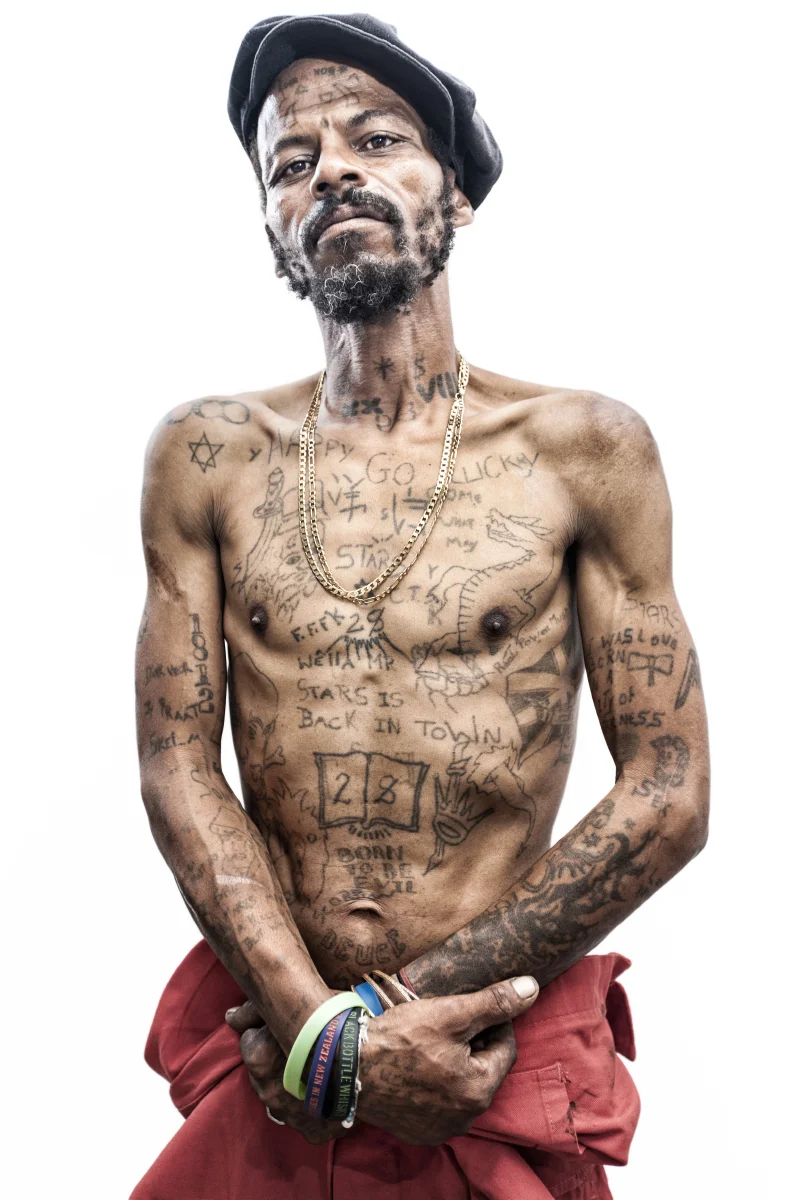
Gerald 'Horings' Hugo
Firstly, what does Tjappies Van Die Point mean?
Tjappies Van Die Point literally means Tattoos From Prison.
Tjappies is a colloquial South African term used to describe tattoos, specifically those rudimentary in aesthetic that, generally, were completed in prison. Information technology originates from an old brand of South African bubblegum—Chappies. The wrappers contain interesting 'did you know' facts. So, the term became associated with prison tattoos considering the markings etched into skin often reveal facts nearly the wearer—crimes committed, gang affiliation, and more than.
And so how did this project begin?
Well, I became interested in tattoos at a young age. I hung out and helped out a few dodgy shops on the 'bad side' of town. So, my introduction to tattooing was always tinged with a criminal element, and I was always fascinated by prison house tattoos—the simplicity, the ingenuity, the craftsmanship.
I've e'er been interested in tattoos in the context of rejecting societal norms. At present, tattoos have get fashionable, but there are still markings which are notwithstanding taboo.
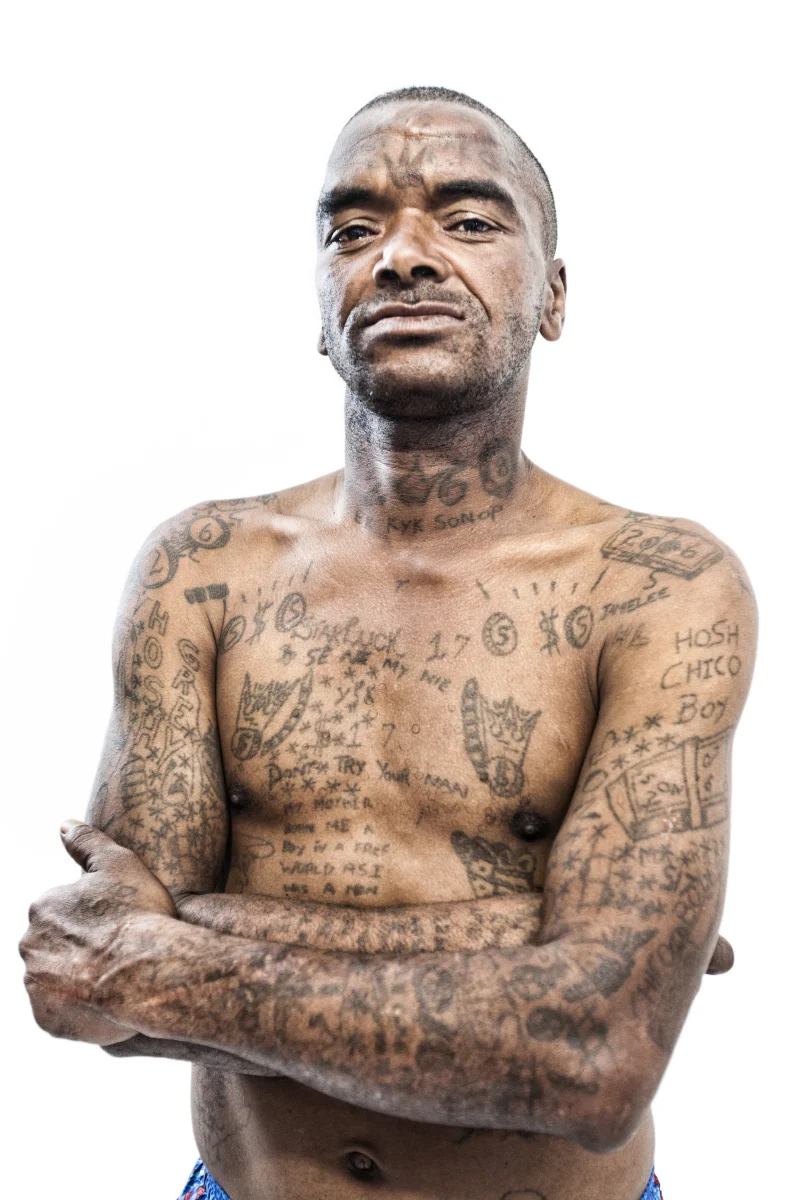
Punzo
Prison tattoos, especially inside the S African context, are even so a purposeful rejection of 'normal society'. The tattoos are easily identifiable as being done in prison and often contain violent and obscene motifs which adorn faces and hands. These tattoos are still symbols of the outlaw, and wearing them comes at a great cost. Add together in the mythology of The Number Gang, which has ruled the Due south African prison system for the terminal century, and how that tale is told through the permanent etchings is storytelling at its almost pure and dangerous.
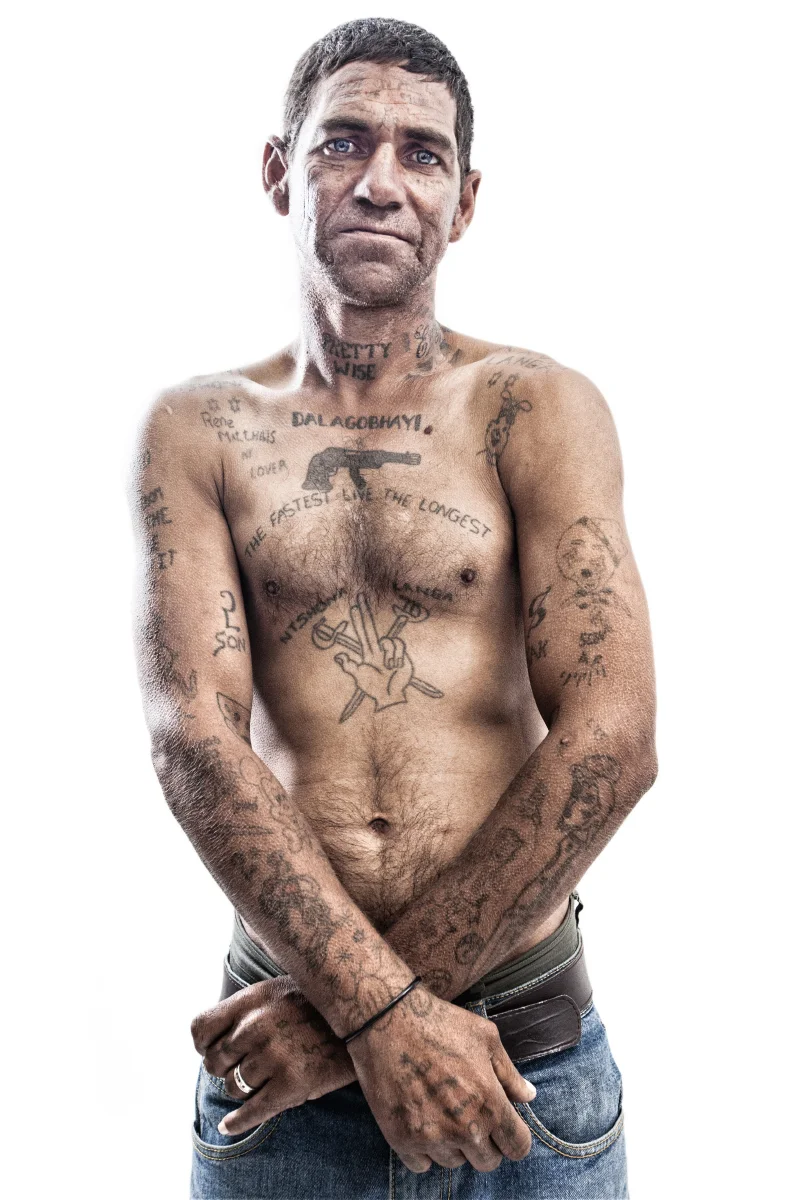
Erefaan
I chose to document these prison tattoos because of their uniquely South African artful, merely, every bit the project went on, it became more than most the procedure of tattooing in prison, the motifs represented, and the societal isolation and discrimination experienced by heavily tattooed convicts. The struggles of reintegration into communities, once released from prison, became all too articulate.
In reality, the project was a fashion for me to deepen my own agreement of South African prison tattoos and the ability behind them.
How do you go nearly recruiting subjects?
I was fortunate plenty to spend a lot of time with a loftier-ranking gang member who had spent over xx years in prison house. We became friends; he was trying to get dorsum on his anxiety after serving serious time but his tattoos had made it hard for him to get a job or reintegrate back into his community. So that got my mind working and I hired him equally a 'talent scout' of sorts, to aid bring the project together by finding people in similar situations.
Every single person I photographed was, or however is, active in gang action—both within prison, as a office of the Number Gang (yous don't ever really leave the Number), and on the exterior as part of some infamous street gangs. Towards the end of the projection I was getting calls from gangsters saying "hey, I hear you're photographing tattooed prisoners – take my photo!".

Hangpaal
Tell me about the Number Gang, how did they come about, who are they and what are they like?
Truthfully, I'yard not at liberty to discuss the Number Gang in great detail. The data is bachelor out at that place, and there are more than a few 'outsiders' who would be willing to spill the beans on The Number.
The greatest thing nearly The Number, though, is its rich mythology and folklore which has remained largely confined to those belonging to the gang, who, in theory, took an adjuration to continue the gang'south dealings a surreptitious. Plainly, these secrets have been divulged over the years. If you'd like to find out more about the Number Gang I recommend reading Jonny Steinberg's The Number. What I volition say is that The Number has by far the most intricate and involved backstory of any other prison house gang I've ever heard of. The history and heritage of The Number stretches back hundreds of years, to a time when immature black men were forced to abandon their rural villages in search of work on the mines in central South Africa and Delagoa Bay (now Maputo, Mozambique).
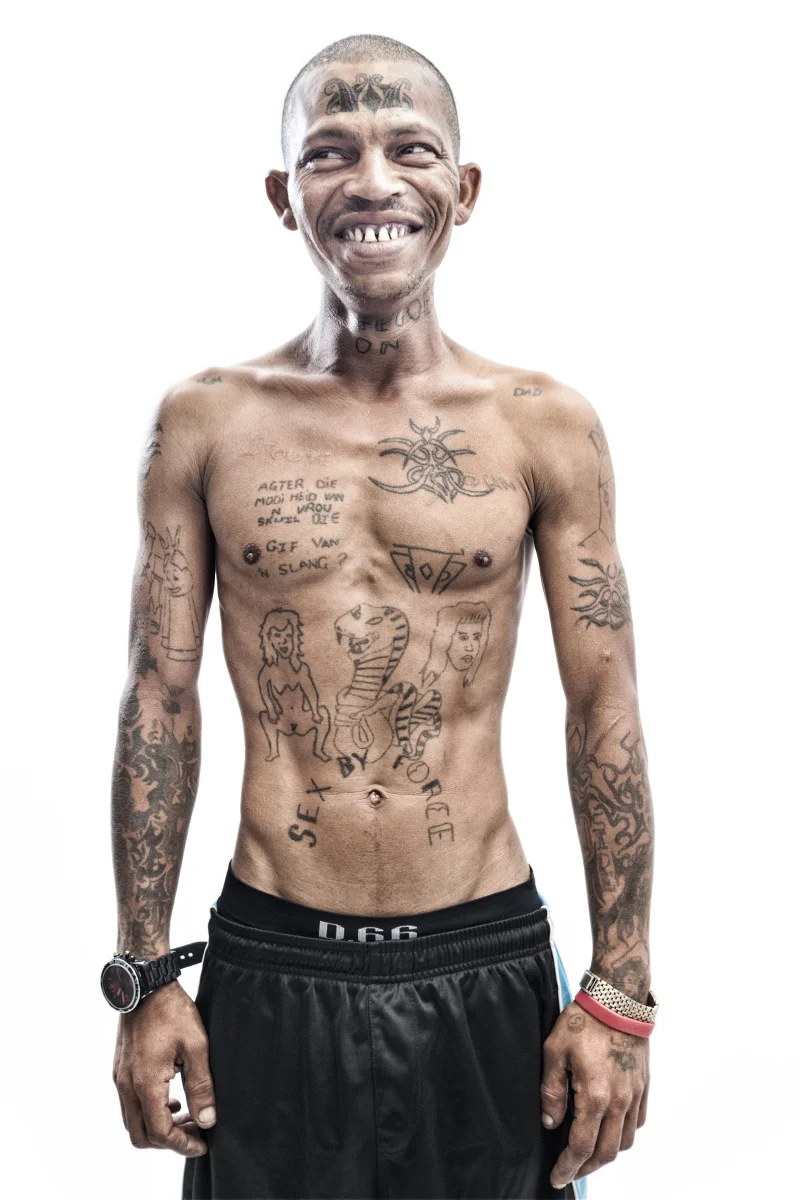
John
How are they positioned in full general Greatcoat Town society?
The Number gang was historically limited to prison—meaning that street gangs ruled the 'outside' world and The Number was the almighty force behind bars. That all changed in the belatedly 1980'due south when Cape Flats drug dealers started making heaps of cash through the mandrax trade.
Substantially, the leaders of street gangs then 'bought' their way into The Number once incarcerated; in order to bypass the gruesome rite of passage required to bring together. For a fee, gang leaders from the exterior world became 'safe' in prison, without having to do much dirty work.
Though, in turn, this upset the residue of things—with The Number spilling out into the 'gratuitous world' by forming solid relationships with street gangs. Simply, the drug lords had the coin on the outside, and The Number had the power on the inside. Drug lords promised Number gang members piece of work on the outside upon their release and this led to a massive explosion of violence on the Greatcoat Flats, something which nevertheless persists today, arguably, worse than always before.
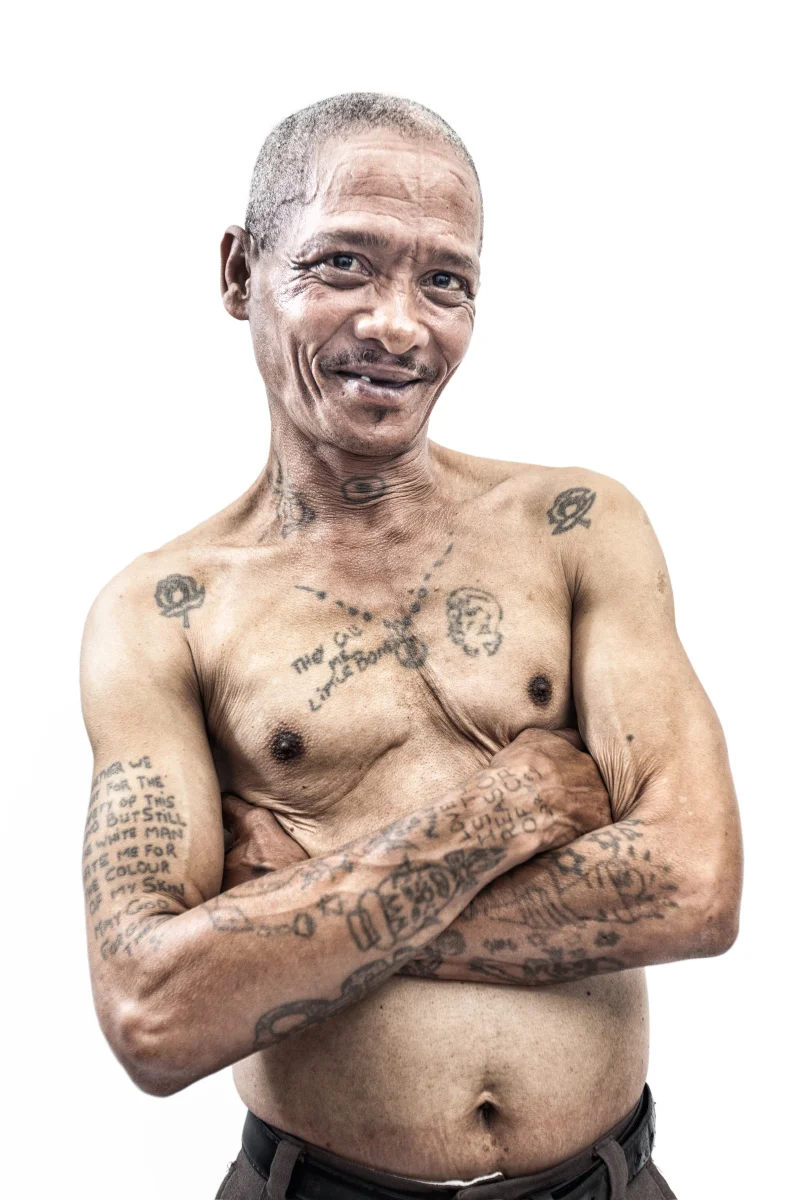
Mandown
Tin y'all tell me nearly some of the members you lot've befriended?
Gerald 'Horings', my friend and fixer, is without dubiety the near outstanding subject and person. He parks cars and collects flake metal to brand ends encounter. Every bit is the case with most of the people I photographed for this project, they're not inherently bad people—only people born into apple-polishing poverty who suffered farthermost trauma and abuse and concluded up making some seriously bad decisions which toll them their lives and brought pain and misery to their ain families and the victims of their crimes.
Almost people I photographed were arrested and convicted of violent crimes—murders and assaults. In prison house, as part of The Number's initiation rites, they committed further trigger-happy acts against other prisoners and warders. Some prisoners, who were sentenced to a few years in jail, ended up spending 30 years behind bars for their commitment to The Number.
I guy, who calls himself 'Mandown', stole a loaf of bread in 1978 and got put into a cell with some loftier ranking Numbers. He got inducted and, due to further crimes committed while incarcerated, ended upwards being released in 2003.
Every single story told is one of heartache, violence and momentary madness.
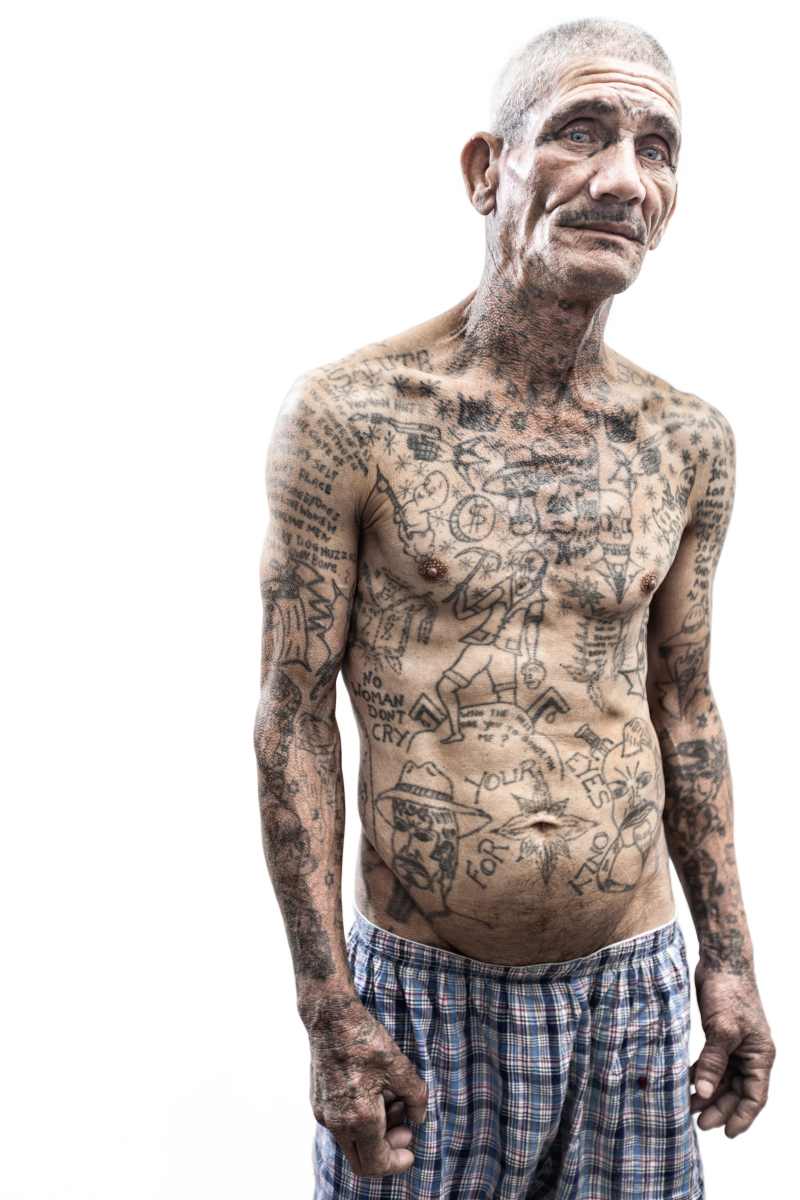
Owen
What kind of equipment would they use to tattoo?
A sharpened guitar string usually serves as the needle. Burnt rubber, turned to ash and mixed with water to grade a paste, serves as ink. All prison tattoos, until very recently, were all washed past hand – no machines.
Can you explain the dissimilar symbology, iconography and meanings you discovered throughout their tattoo motifs?
Well, without going into likewise much detail near the inner workings of The Number, there are key elements of the gang that are important to understand within the context of the markings.
The 26's are tasked with gaining currency within the prison, either through money or contraband, drugs, tobacco, that sort of affair. They're master smugglers and manipulators. They're said to work from sunrise—hence the term 'sonop' (sunrise) being a common greeting and motif present in the tattoos. Pumalanga, the Zulu give-and-take for sunrise, is too used.

Close-upwards of Hangpaal'south Tattoos
The 27'southward are tasked with upholding the police of The Number and are the most feared and dedicated gang members. Their motifs often include weaponry, crossed cutlasses, and verses relating to the rule of police within The Number.
The 28'southward are, traditionally, tasked with defending prisoner rights, usually through force, such as attacking prison officials should The Number not receive adequate attention and respect from regime. They also dominate underlings, and non-gang members, by the utilize of sexual force, i.e. sodomy. Motifs including obscene sexual scenes and penises are common. In contrast to the 26'due south, they work at night, and tattoos often relate to 'sonsak' or 'Shonalanga', Afrikaans and Zulu for sunrise, respectively.
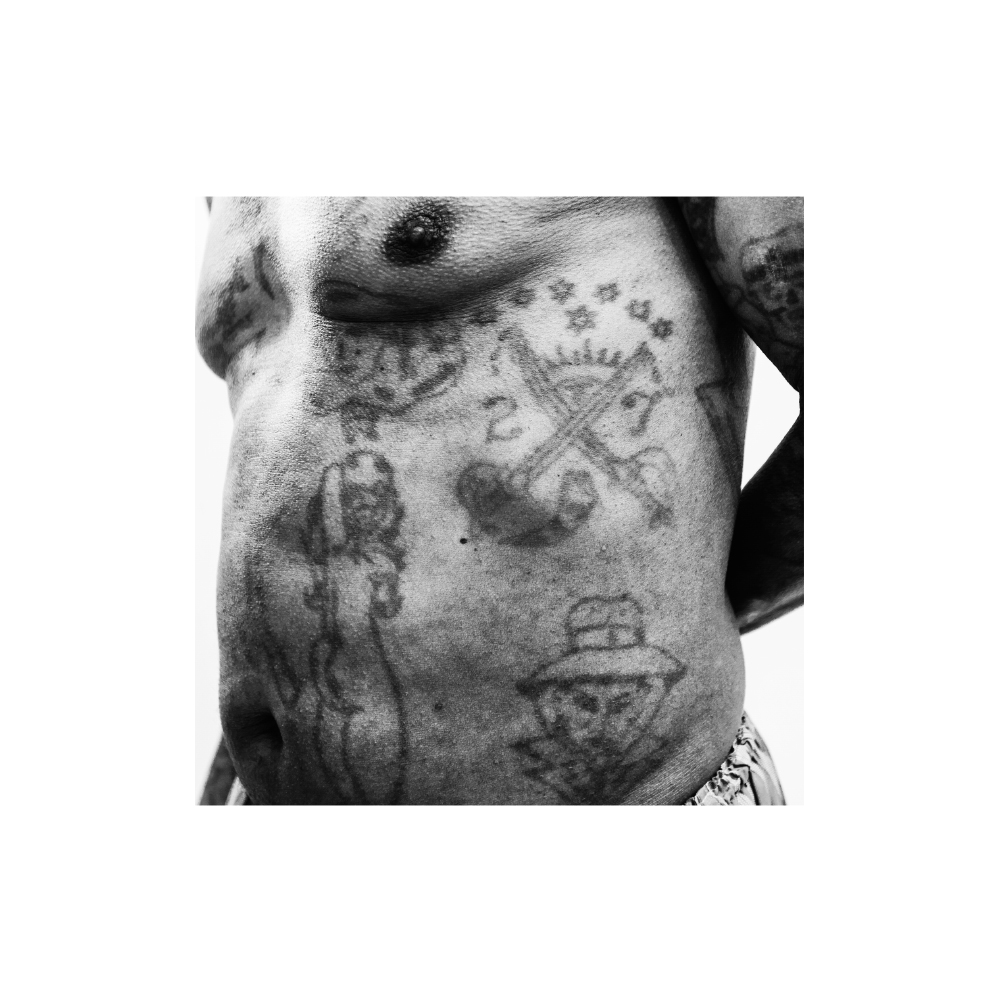
Shut-up of Desmond's Tattoos
What stood out to me is the juxtaposition involving hardened criminals and comical cartoon motifs. Despite some of the people I photographed having committed heinous crimes, many of them had blithesome cartoon characters tattooed on their bodies. This is because, I'thousand told, comic strips in prison formed the ground for many 'stencils'; in other words, very often imagery available to prisoners was limited to cartoons establish in newspapers.
Another thing which fascinated me was the presence of script-heavy tattoos. Some guys had their whole backs filled in writing—hundreds of words—most in broken English, despite most of the wearers and tattooers being Afrikaans. The essays inked into their bodies tell stories of life's hardships, gang folklore, and self-inflicted isolation from normal lodge.
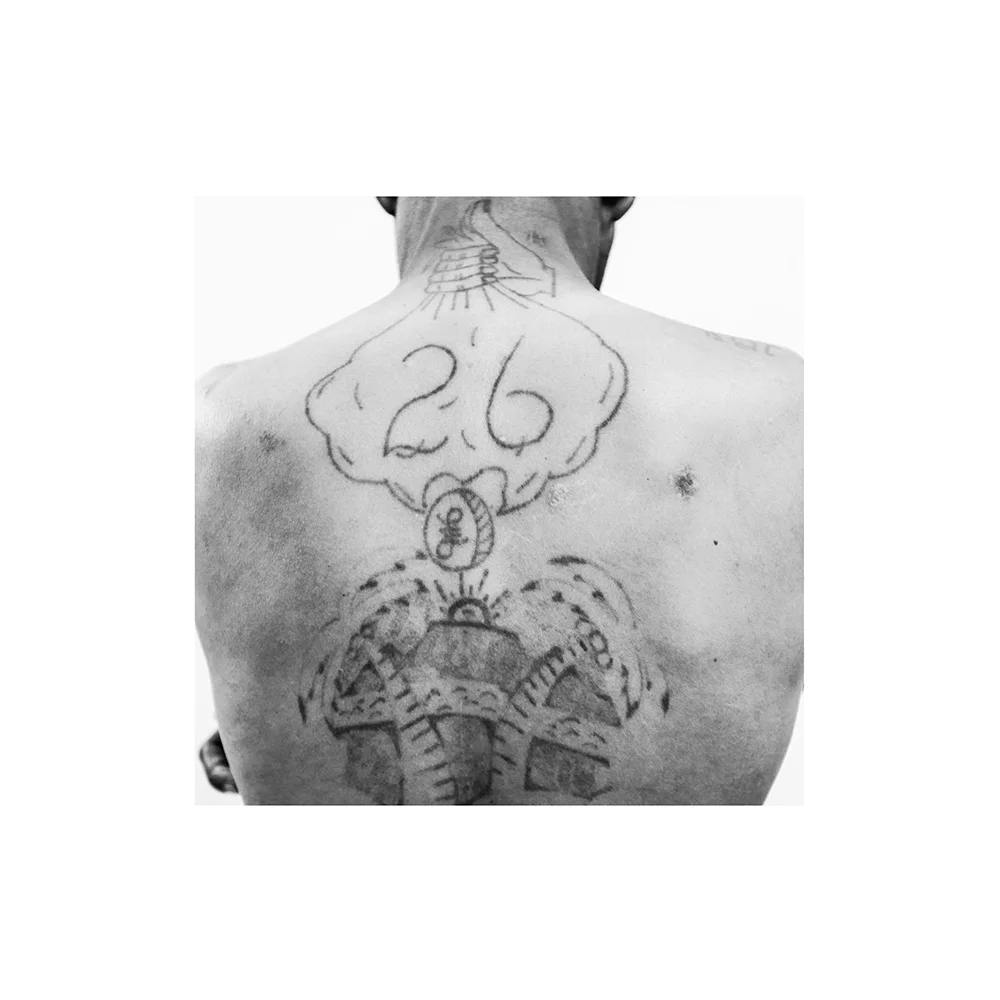
Close-up of Punzo's Tattoos
And any outstanding tattoos?
The penis tattoos worn by the 28'due south are iconic in their ain right. Drawing characters juxtaposed alongside rape and murder scenes are interesting, in a repulsive kind of way.
The tattoo which is most important to me is a phrase I was 'gifted' by Gerald 'Horings', which reads "Go tell it to the birds". It's the nearly meaningful to me—I got it tattooed on my neck.
The tattoos are intrinsically linked to the personalities of the people that wear them, but relate more to the crimes committed, and time served equally a result, more than a defining overarching theme of their entire lives, dreams or aspirations.

Pieter
In South African prisons, as I'thou quite sure is the case in most jails all over the world, prisoners get tattooed, heavily tattooed, to appear more intimidating and to further reject societal norms. Face tattoos baring obscene phrases are common—this is a complex blend between ego and self-destruction. It's these kinds of tattoos which will earn respect and notoriety behind confined simply impairment the person'south chances of ever successfully reintegrating back into order. Nobody wants to rent somebody with 'fuck yous' inked into their forehead—but in prison, that kind of anti-establishment, nihilistic mental attitude is appreciated.
Most of the people I photographed are proud of their tattoos, despite the pain and trauma contained within the markings equally reminders of a night past. In many cases, the tattoos are regarded as battle scars.
Source: https://www.the4thwall.net/blog/thenumber
Posted by: castanedaevely1942.blogspot.com
0 Response to "What Does The Number 25 Mean When A Gang Member Tattoos"
Post a Comment